
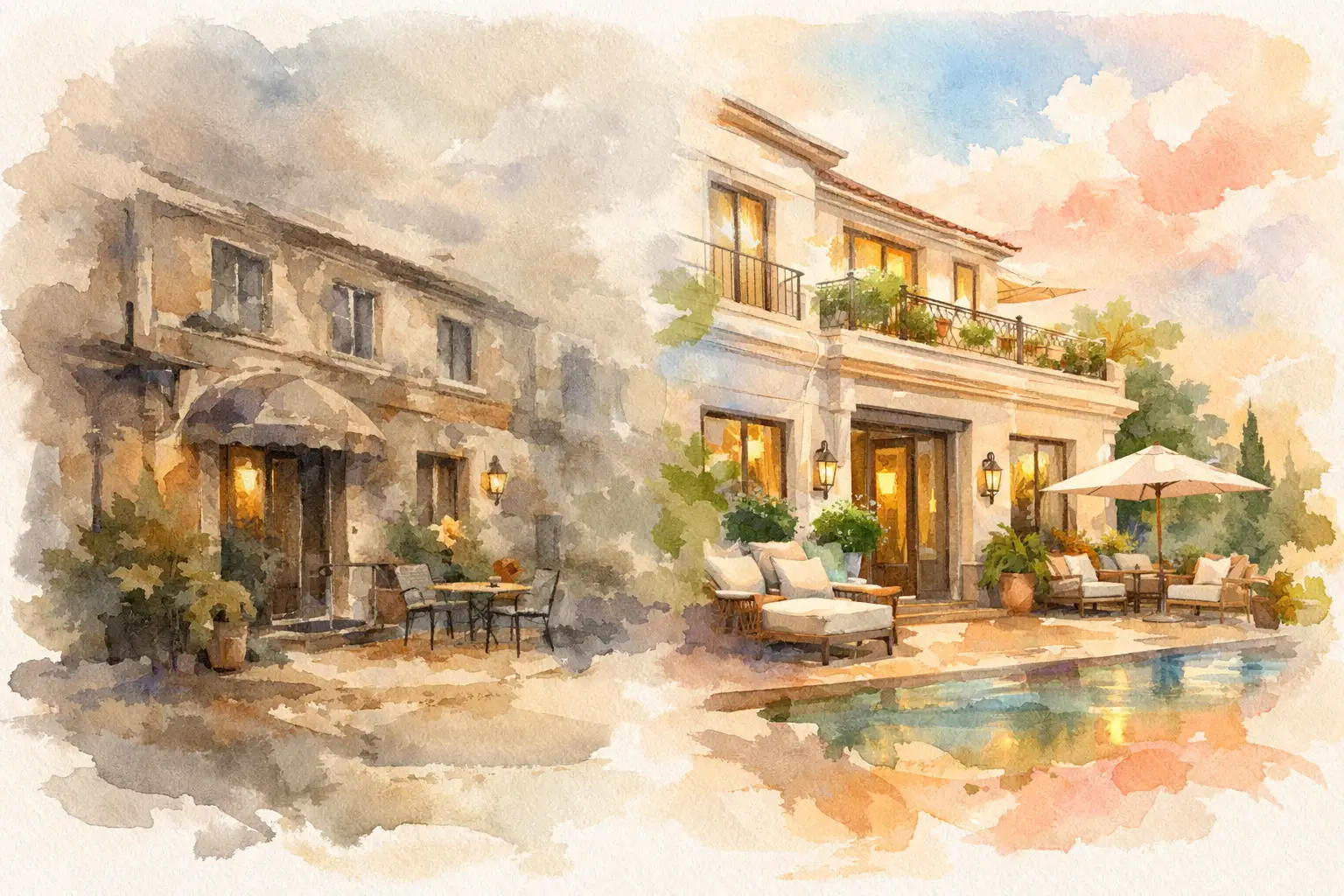
A tired lobby, inconsistent photos, and a booking engine built around discounts can make a well-located hotel feel interchangeable. The most compelling boutique hotel rebrand before and after stories are not about a new logo. They are about changing the reason guests choose the property, the price they are willing to pay, and the path that gets them to book direct.
For owners acquiring an independent hotel or repositioning an underperforming asset, that distinction matters. Cosmetic improvements may earn compliments. Brand infrastructure creates demand. It gives the property a clear role in the market, turns operational details into guest-facing proof, and connects every touchpoint to a stronger commercial outcome.
What a Boutique Hotel Rebrand Looks Like Before
Before a successful rebrand, the issue is rarely that the hotel has nothing to offer. More often, its strongest assets are hidden in plain sight. A historic building may be marketed like any other downtown stay. A property near a sought-after district may communicate nothing about how guests can experience it. A team known for exceptional service may have no consistent story, standards, or digital presence to turn that service into demand.
The symptoms tend to show up across the business. The website leads with room inventory instead of a reason to stay. Visuals are attractive but generic. Review themes point to genuine strengths, yet those strengths never appear in marketing. Revenue depends too heavily on online travel agencies, promotional pricing, or last-minute demand. Sales and operations describe the hotel differently because nobody has established a shared brand promise.
This is where many owners make an expensive mistake: they treat the challenge as a design refresh. Design matters, but it cannot solve unclear positioning. If the market cannot quickly understand who the hotel is for, why it is distinct, and what kind of stay it delivers, a cleaner identity simply packages the same ambiguity more beautifully.
The real cost of being generic
Generic hotels compete on availability, location, and price. That leaves little room for rate confidence, especially when larger brands can outspend independents on distribution and loyalty programs.
A focused boutique brand creates a different comparison set. Rather than competing with every hotel within a five-mile radius, it earns consideration from guests seeking a particular mood, neighborhood connection, service style, design point of view, or purpose for travel. That specificity is not limiting. It is the foundation of pricing power.
The After: A Brand That Changes Demand
The “after” version of a boutique hotel is not merely more polished. It is more legible, more memorable, and easier to choose.
The property has a defined market position built on real advantages. Its name, identity, photography, voice, room descriptions, amenities, local partnerships, and guest communications all reinforce the same idea. Guests encounter a cohesive story from the first search through check-in and checkout. That consistency builds confidence before a reservation is ever made.
Just as important, the brand gives the operating team a lens for decision-making. If the hotel promises quiet, design-led restoration, the arrival sequence, scent, playlist, room collateral, and service cadence should support that feeling. If it is positioned as a social home base for a creative district, public spaces, programming, and neighborhood recommendations need to earn the claim.
The result is an experience that feels intentional rather than assembled. Guests are more likely to remember it, recommend it, return to it, and pay for it.
Boutique Hotel Rebrand Before and After: What Actually Changes
A meaningful rebrand changes three connected systems: strategy, experience, and performance marketing. Leave out one, and the investment loses force.
1. Positioning moves from broad appeal to clear preference
Before, the hotel may claim to be “unique,” “luxury,” or “a home away from home.” Those phrases are common enough to mean very little. After, the brand articulates a specific value proposition rooted in the property, its location, and the guest it can serve better than competitors.
That work requires hard choices. A hotel cannot credibly be an intimate romantic escape, a high-energy group hub, a corporate convenience play, and a family resort all at once. It may welcome several audiences, but the brand must establish a primary emotional and commercial center.
The strongest position is not invented in a workshop. It is uncovered through market analysis, guest feedback, competitive review, ownership goals, and the operational reality of the asset. A brilliant concept that the property cannot deliver will damage trust faster than no concept at all.
2. The guest experience becomes evidence of the story
A brand promise becomes valuable when guests can feel it. This does not always require a full renovation. In some cases, better lighting, upgraded bedding, sharper signage, staff language, a thoughtful arrival ritual, and a more useful neighborhood guide can reshape perception quickly.
In other cases, the gap is structural. A property pursuing a premium rate may need to address tired bathrooms, poor soundproofing, weak public spaces, or unreliable service before spending heavily on a high-end campaign. Marketing can accelerate awareness, but it cannot protect a promise that the guest experience breaks.
This is the practical discipline behind experience-driven branding: invest where the guest notices. Not every back-of-house improvement belongs in the brand story, but every visible friction point can weaken it.
3. Marketing shifts from scattered activity to a conversion system
The rebranded hotel should not launch with a new identity and then return to disconnected campaigns. Its marketing needs a system that carries the position into discovery, evaluation, and booking.
That includes a website built around the value of the stay, not just room types. It includes photography that captures atmosphere and proof, not only empty interiors. It includes search, social, email, partnerships, and paid media that speak to the audiences most likely to value the experience. And it includes a direct booking path that makes the decision simple.
The goal is not to eliminate online travel agencies overnight. They still play a role in visibility and occupancy. The goal is to reduce unnecessary dependence by giving guests a stronger reason to book through the hotel itself, where margins, data, and future relationships are more valuable.
Measure More Than the Reveal
A rebrand should be evaluated as a business investment, not a launch-day event. Owners should establish a baseline before work begins and track what changes after the new brand enters the market.
The most relevant measures depend on the property’s goals, but typically include average daily rate, revenue per available room, direct booking share, website conversion rate, cost of acquisition, length of stay, repeat guest behavior, and review sentiment. For a hotel with a strong food and beverage, events, or retail component, ancillary spend and local audience engagement may matter just as much.
Context matters. A rate increase is not automatically a win if occupancy collapses. Higher web traffic is not a victory if visitors do not convert. Better social engagement has limited value if it never reaches likely guests. The strongest before-and-after case is a pattern: clearer demand, healthier margins, stronger guest perception, and a team that can consistently deliver the brand.
The Rebrand Sequence That Protects the Investment
Owners often feel pressure to move fast after an acquisition or during a turnaround. Speed can be valuable, but skipping the foundation creates rework. A better sequence begins with the commercial objective: Is the priority to raise rate, capture more direct demand, enter a new segment, improve the asset’s saleability, or stabilize performance after a decline?
From there, define the market position and brand story, then translate that strategy into guest experience standards and a visual and verbal identity. Build the website, sales materials, launch campaign, and content plan around the approved direction. Finally, train the team and monitor performance closely once the market begins responding.
This is why YKMD treats brand development as infrastructure through its Tri-Create System™. The work must align what the hotel promises, what the guest receives, and how demand is generated. When those pieces are built in isolation, the property pays for fragmentation at every stage.
When a Rebrand Is Not the First Move
A rebrand is powerful, but it is not a substitute for solving fundamental operational problems. If rooms are consistently out of order, service recovery is weak, cleanliness is unreliable, or ownership has not defined the property’s investment capacity, start there.
Likewise, a rebrand may not be necessary if the hotel already has strong recognition and clear guest loyalty but suffers from a narrow channel issue. In that case, improving the website, rate strategy, CRM, or paid media approach could produce faster returns than a full repositioning.
The right question is not, “Do we need a new look?” It is, “What is preventing this asset from earning the demand and rate it should?” Sometimes the answer is brand. Often, it is brand connected to experience and marketing. The diagnosis determines the investment.
A hotel becomes truly valuable when its reputation does some of the selling before a guest compares rates. Build a brand that gives people a reason to choose the stay, talk about it afterward, and come back when the next trip calls for more than a room.